
Hey loves,
Social media fitness did not begin as something inherently harmful. At its inception, it functioned as a democratizing force, offering women access to information, methods, and visual representations of strength that were once reserved for elite athletes, private gyms, or tightly guarded coaching circles.
For many women, seeing female bodies lift heavy, move confidently, and occupy physical space with authority was not only novel but quietly liberating.
Yet somewhere along the way, fitness shifted from something women practiced into something women increasingly performed.
The transition was gradual enough to escape scrutiny. Training, once allowed to be repetitive, private, and unremarkable, became aestheticized, narrated, and carefully curated.
Movement was no longer simply movement; it was filmed, edited, captioned, and contextualized. The body itself became a form of proof, evidence of discipline, self-control, and personal value, rather than the byproduct of a long-term physiological process.
What changed was not exercise itself, but the relationship women began to have with it.
Women have long been socialized to monitor themselves: their posture, their tone, their appearance, the way they occupy space.
Social media did not invent this reflex; it intensified it. Fitness, which once offered a rare space where effort could exist without constant evaluation, became another arena in which the female body was watched, interpreted, and silently corrected.
Over time, training decisions subtly adapted to the presence of the camera. Exercises were chosen not primarily for what they built, but for how they appeared.
Programs prioritized novelty over progression, stimulation over adaptation. Consistency, once the quiet backbone of physical change, lost its appeal, while visibility gained disproportionate importance.
There is nothing inherently wrong with sharing workouts or documenting progress. The issue is that the mechanisms of social media do not reward what actually works.
Strength is slow, cumulative, and visually understated. Nervous system regulation does not translate cleanly into clips. Bone density, tendon resilience, and muscular maturity resist immediacy and spectacle.
Social media favors the immediate. Fitness does not.
As a result, many women began training not for long-term adaptation, but for short-term appearance, how a movement looks under gym lighting, how a pump photographs, how discipline reads in a frame.
The goal quietly shifted from becoming stronger to appearing disciplined.
In this environment, watching replaced doing, saving replaced following, and information accumulated faster than embodied understanding.
The body, which learns through repetition and patience, was asked to adapt at the pace of an algorithm.
This shift carries a unique psychological cost for women because fitness has never existed in a purely physical vacuum.
It is intertwined with worth, desirability, and social belonging. When training becomes something that must be externally validated, rest begins to feel suspicious, simplicity feels inadequate, and progress that cannot be displayed feels incomplete or unreal.
Strength training endures this distortion better than most practices, not because it is immune to trends, but because it is structurally resistant to them.
Strength does not respond to rushing. It cannot be aestheticized indefinitely without consequence. It demands patience, repetition, boredom, and trust: qualities that are difficult to perform and even harder to monetize.
There is a particular kind of freedom in private fitness. In unglamorous sessions, in imperfect repetitions, in weeks where progress is felt internally rather than displayed externally. In allowing the body to adapt without explanation or commentary.
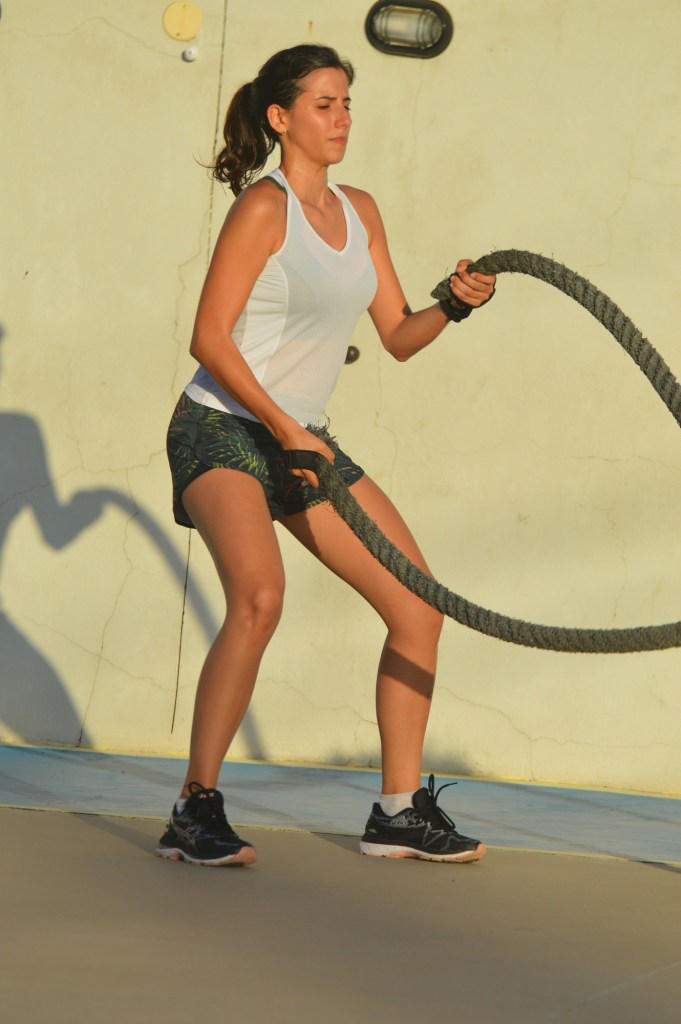
Reclaiming fitness does not require rejecting social media entirely. It requires remembering that the most meaningful changes, resilience, posture, confidence, nervous system stability, occur outside the frame.
That the body transforms quietly, often invisibly, long before it looks different.
Fitness was never meant to be watched, it was meant to be practiced.
And when women return to practice, something essential shifts. The impulse to prove softens. Training becomes less about being seen correctly and more about becoming capable.
Strength, in its truest form, reclaims its original function, not as performance, but as presence.
I hope that you enjoyed this blog post on How Social Media Rewired the Way Women Train, please let me know what you thought about it in the comments section below!

 Taras Fit World